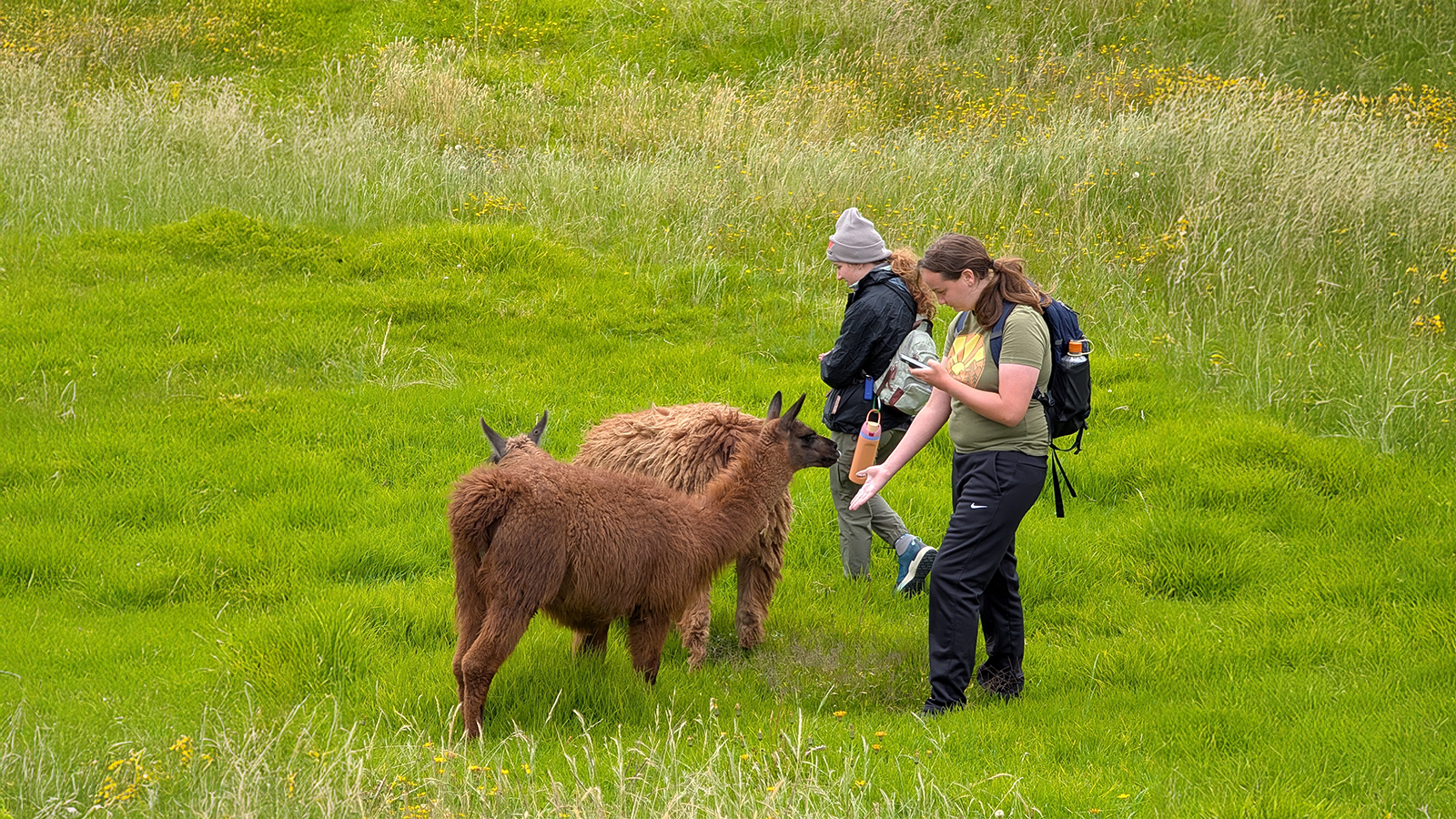
Ecuador Program—Summer 2027
Preliminary applicationEcuador Program – Summer 2027 Field Program (7/6–7/27)
You want to be here. The community partners we work with are excited to have us return to continue the work. Our 2027 program will involve mostly local community service, reconnaissance, and lab organization for the month of July. Students would enroll in three courses, Anth 12 (Applied Anthro - 4 units), Anth 17L (Lab Analysis - 2 units), and Anth 51 (Survey - 2 units), that will focus on indigenous archaeology and cover the basics of artifact analysis and survey, as we continue to uncover clues to the legendary history of the area and work with community members. Ecuadorian people were able to muster incredible resistance to colonial forces, and that spirit remains today. Indigenous Quichua-speaking peoples managed to hold off the Inka, the Spanish, and now multinational corporations since the 1400s. Is it the water? The climate? What is it about the peoples of the paramo (high grasslands) that gives them the ability to continue in the face of blatant imperialism?
If you are interested, please fill out the preliminary application so we can contact you directly with more information.
Who Can Apply?Anyone 18 or over can apply to the program. We are asking for a working knowledge of SPANISH (the basics). Often we have large programs of over 50 people, but this summer we are looking to run the program at a smaller size. We will be selective in our application process as there will not be as much space to accommodate students this year. We urge everyone to apply and we will let you know as soon as possible whether you have been accepted to the program. |
Program Overview
Discover with us the beauty of Ecuador as we continue our investigation of the landscapes surrounding the Pre-Columbian sites of Pambamarca. Join us in South America this summer for an excellent archaeology and cultural experience with coursework and field trips.
Live with us and other project members in the Andes. Learn about all aspects of the research project, including archaeological survey and excavation and community development activities, with a focus on laboratory work.
Check out the informational video from Dr. Connell above.
Project Directors & Affiliated Professors
-
Samuel V. Connell, PhD (Foothill College)
-
Ana Lucía González, MA (Foothill College)
-
Chad Gifford, PhD (Columbia University)
-
Zev Cossin, PhD (American University)
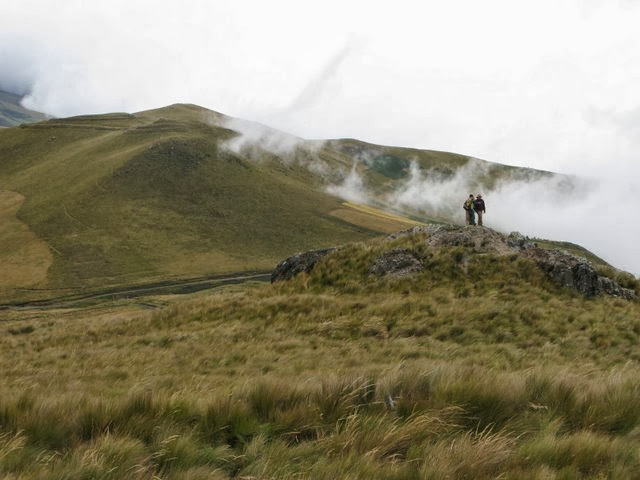
What Will You Be Doing in Ecuador?
You will be living in the majestic Andes of South America at 10,000 feet. You will be visiting incredible archaeological sites, learning about a country by immersing yourself in the culture of a people, and experiencing places you won't believe exist.
Days will be spent immersed in the culture of Ecuador, both past and present. Students will learn the basic field techniques of archaeology, including excavation, survey, and laboratory analysis. Classwork will cover archaeology methods and theory, as well as South American archaeology and history. For more details about our research and past findings, see the Pambamarca project website and bibliography section below.
Field trips, called Faculty Developed Practica (FDP), are designed to foster intercultural knowledge. Students will travel to indigenous communities, market towns, ancient archaeological sites, and museums.
We are a short ride to the town of Cayambe, a little over an hour from Quito on weekends. The world-famous artisans and market of Otavalo are located only a half hour to the north. For the adventurous, the headwaters of the Amazon River, the majestic Pacific coastline, and even the Galapagos Islands are a short plane trip away. Ecuador is truly remarkable, and we are excited to share its wonders with you while also doing interesting archaeology.
Students reside in Pambamarca, in the town of Cangahua, located in Cayambe County on the northeastern edge of Pichincha Province, about an hour north-northeast of Quito. Cangahua sits south of Cayambe and is a small, open, and enjoyable town.
Participants stay in a dormitory-style house behind the main church (‘Casa Comunal’) with electricity, running water, showers, a kitchen, a mess hall, and beds. Meals are prepared by two cooks hired annually, offering healthy and delicious food.
Students may also choose, at extra cost, to stay at Hacienda Guachalá – www.guachala.com.
All ages are welcome, from high school graduates to retirees. Students may proceed at their own pace.
The Pambamarca project area contains the largest concentration of pre-Columbian forts in the New World (Hyslop 1990). We have been working here since 2001 excavating and surveying at the forts. We know from the Spanish chroniclers that the Inca Empire tried to conquer the Ecuadorian people beginning around 1490 and that the people of Ecuador put up a famous resistance which forced the Inca to construct fortresses over many years until finally the conquest ended in the murder of most of the Ecuadorian army at Lago Yaguarcocha or the Lake of Blood. The purpose of our study is to examine the sequence of occupation and activity in and around Pambamarca. What we have found out so far is that
- Evidence for warfare is everywhere
- People built these sites at different times and for different purposes.
- There are different kinds of sites in the Pambamarca complex, including castle-like pucara (Inca forts) and other non-military sites that seem to be more religious and less military.
- There are roads connecting all the sites.
- We need to learn so much more!
Our work in 2027 will continue researching these amazing sites and expand our survey in the Andean highlands. Our aim is to document all of the sites and find out why so many forts were built in this critical geographic location. In addition, we hope to uncover the differences between the Inka and Cayambe warfare tactics. Finally, we will be trying to understand what made the Cayambe so successful at resisting the Inka when the rest of South America fell so quickly.
Student fieldwork typically begins at a Spanish-era colonial hacienda, where we learn field techniques, and quickly move to the other sites for the rest of the field season. Plans in 2027 will include analysis of artifacts from excavations at important Cayambe sites and Inka fortresses. Preliminary survey and exploration of ancient road systems will continue into the Amazon basin.
Students are trained in laboratory analysis this summer. Our typical student this summer may be someone with previous experience in survey and excavation who would like to be in the lab for a few weeks, or you simply want to come to Ecuador and learn about archaeology and anthropology! The project also utilizes Ground Penetrating Radar (GPR) to detect subsurface features and uses a Geographic Information System (GIS) to analyze data, but this summer we will not have the GPR in the country, although we are planning a 3D photogrammetry project that students will be involved in.
For too long archaeologists have been involving themselves in research without a coherent plan for using anthropology to work with the local peoples in different capacities. This summer we will be working closely with Ecuadorian community members who are interested in putting together a local museum. Students who are interested in aspects of public archaeology will be working closely with the project directors and the community members to create a shared vision for a permanent installation within the town of Cangahua. These are exciting times to be a part of the program.
All participants must commit to active and positive engagement in all program components. Students will earn 6 units of credit from Foothill College for successful completion of the program. The classes you will be taking are
- ANTH12 – Applied Anthropology (4 units)
- ANTH17L – Archaeology Laboratory Methods (2 units)
- ANTH51 – Archaeology Survey (2 units)
All of these courses are fully transferable to your universities.
The field program is broken down into different parts, and everything will be very accelerated. The field and lab training portions of the program involve all the aspects of archaeology, preparing the student to operate in a field archaeology environment anywhere in the world. Benefiting from the over 100 years of combined staff experience in teaching archaeology, each student is instructed in methods of site reconnaissance, surveying, excavation techniques, data recording, photography, and drawing. In the laboratory, students are guided through different aspects of artifact analysis, such as ceramic typology and stone tool production experiments.
A field journal will be covered every day in the field and will be handed in by the student to the professors. The journal will cover the research being conducted and critically analyze the experience as it is ongoing. We find it is important for our students to reflect upon the daily rhythm of their lives. We will also require one or two blog posts during the trip.
FAQs & Program Essentials
Anyone with a high school diploma who will be 18 or over when we travel.
Certainly not.
We are working on this through the Foothill Foundation and Financial Aid at Foothill.
All students will be arriving at Quito’s international airport on or before July 6th. If you arrive on July 6th, a senior project member will be picking you up. If you arrive before you are on your own, you will be given detailed instructions for how to get to our main project living quarters, or you can just meet us at the airport on the 6th of August! It is actually quite easy, and we are big proponents of arriving early and staying later as part of your adventure to South America. Most students make friends and decide to stay later traveling. You are already there, so you might as well see the world!
Dr. Samuel Connell
Department of Anthropology
Foothill College
12345 El Monte Rd.
Los Altos Hills, CA 94022
USA
(650) 949-7197
connellsamuel@foothill.edu
Please do not hesitate to email or call if you have any questions.
All the necessary information is found on the Pambamarca website
Students from the today and the past are talking on the Pambamarca Facebook Page
Bibliography
- Connell, Gifford, et al., "Hard Times in Ecuador." Antiquity. 77: 295. 2003.
- D'Altroy, Terrence, The Incas (The Peoples of America). Blackwell Publishing, 2003.
- Newson, Elizabeth, Life and Death in Early Colonial Ecuador. University of Oklahoma Press, 1995.
- Cieza de León, Pedro de, The Discovery and Conquest of Peru: Chronicles of the New World Encounter. Durham and London: Duke University Press, 1998.
- Athens, J. S., II, "Ethnicity and Adaptation: The Late Period-Cara Occupation in Northern Highland Ecuador," in Resources, Power, and Interregional Interaction, edited by E.M. Schortman and P.A. Urban. 193-219. New York: Plenum Press, 1992.
- Hyslop, John, Inka Settlement Planning. University of Texas Press, 1990.
Still Have questions?Find all the answers on the Pambamarca Project Website. |

Contact UsAnthropology DepartmentBuilding 3000, Office 3017, Main CampusSamuel Connell 650.949.7197 Kathryn Maurer 650.949.7751 Julie Jenkins 650.949.7430 |
