Find answers to common questions about the program, including eligibility, requirements,
deadlines, costs, and other important information.
Curriculum, Clinical Education & Career Preparation
The Neurodiagnostic Technology Program is a rigorous, full-time healthcare education
program combining scientific coursework, laboratory training, and supervised clinical
education. Students must demonstrate proficiency in both theoretical knowledge and
practical skills while maintaining satisfactory academic and clinical performance
throughout the program.
Students should anticipate independent study time in addition to scheduled lectures,
laboratory sessions, and clinical rotations. Coursework requires an understanding
of neuroanatomy, neurophysiology, neurological disorders, and technical procedures.
Consistent preparation and effective time management are essential for success.
The majority of classroom instruction will be scheduled during daytime hours. However,
some courses may be offered in a hybrid format, and certain laboratory sessions or
clinical rotations may require evening attendance. Students should anticipate flexibility
in their schedules to accommodate the academic, laboratory, and clinical requirements
throughout the program.
While students may be able to maintain part-time employment, the Neurodiagnostic Technology
Program is a rigorous, full-time program requiring a significant commitment to classroom
instruction, laboratory training, clinical rotations, and independent study. Maintaining
full-time employment while enrolled may be particularly challenging due to the program’s
academic demands and clinical scheduling requirements. Students are encouraged to
carefully evaluate their work commitments and availability to ensure they can successfully
meet all program requirements.
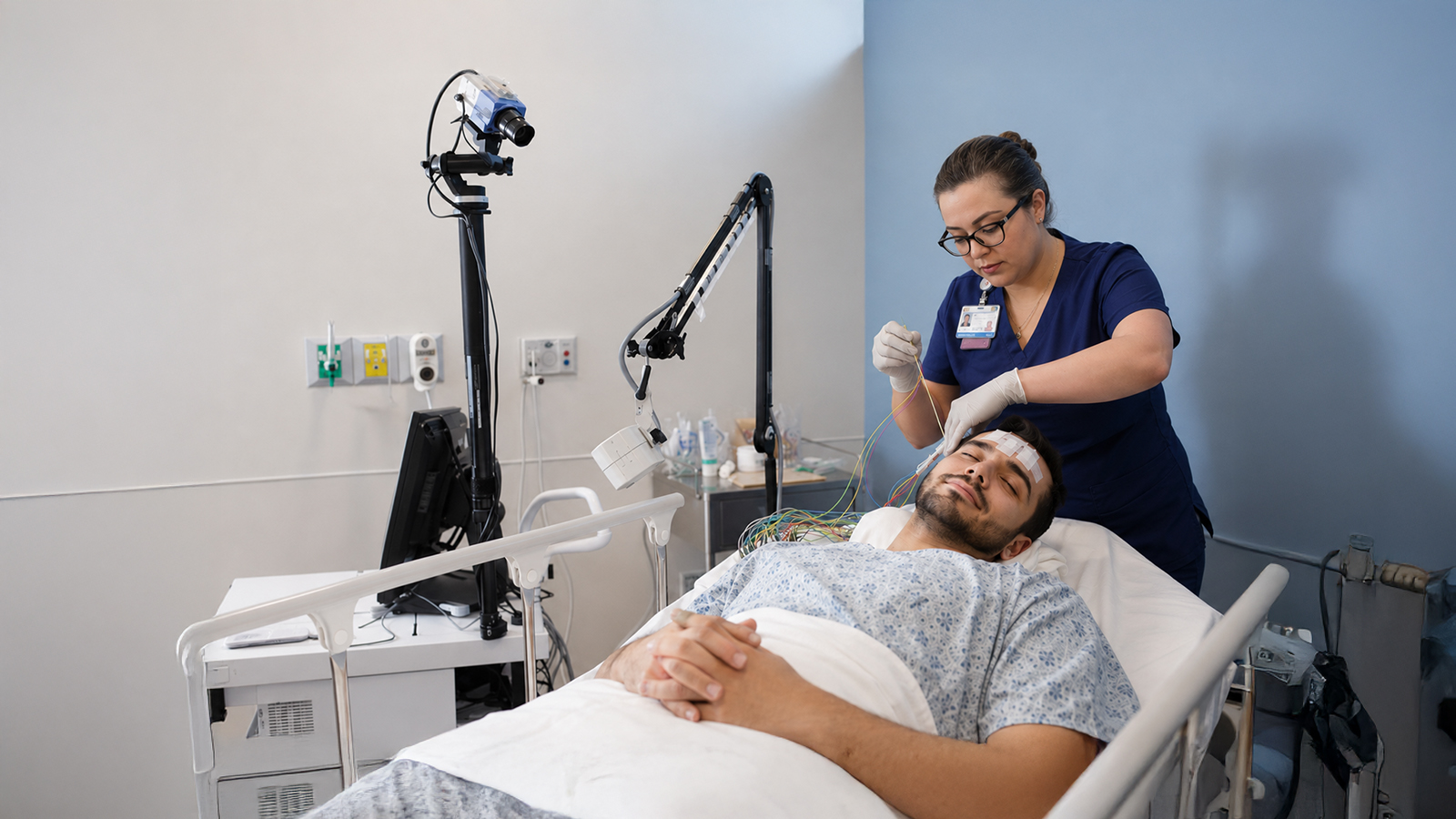
Yes. Students participate in structured skills laboratories where they develop technical
competencies, including electrode application, equipment operation, recording techniques,
artifact recognition, and patient safety. These foundational skills are developed
and evaluated before students progress to supervised clinical responsibilities.
Yes. Students are responsible for purchasing or renting required textbooks and obtaining
designated course materials. Students will also be required to purchase a neurodiagnostic
laboratory kit containing essential supplies and equipment used to develop and practice
foundational technical skills, including electrode application for EEG and other neurodiagnostic
procedures. These materials will support hands-on skill development throughout the
program, both during scheduled laboratory sessions and through independent practice.
No. Clinical rotations are coordinated and assigned by the program through affiliated
healthcare facilities. Students are not responsible for securing their own clinical
placements but must meet all clinical onboarding requirements and arrange reliable
transportation to their assigned facilities.
No. Clinical sites and schedules are assigned by the program based on educational
objectives, clinical site availability, and program requirements. The majority of
clinical rotations will take place during daytime hours; however, some assignments
may include evenings or weekends. Students are expected to attend their assigned clinical
site and scheduled hours and must arrange reliable transportation to healthcare facilities
throughout Northern California
Students are evaluated throughout their clinical rotations using established performance
standards. Those experiencing difficulty may receive additional instruction, feedback,
and opportunities for improvement in accordance with program policies. Continued inability
to meet required competencies may affect clinical progression and eligibility to continue
in the program.
Yes. Clinical education is designed to expose students to a variety of patient populations
and healthcare settings, including routine EEG laboratories, inpatient units, epilepsy
monitoring units, and critical care environments. Specialty experiences may also be
available depending on clinical site resources.
The program is designed to prepare graduates for entry-level neurodiagnostic practice
through progressive classroom, laboratory, and clinical education. Students will develop
the technical knowledge, patient care skills, and professional judgment necessary
to transition into the workforce. Additional employer-specific orientation and training
may be required after graduation.
Neurodiagnostic technologists may pursue additional professional credentials and specialized
experience in areas such as Long-Term Monitoring, Intraoperative Neuromonitoring,
Evoked Potentials, and other neurodiagnostic procedures. With experience and additional
qualifications, technologists may advance into leadership, education, research, clinical
coordination, or management positions.
Applications, Admissions & Prerequisites
Applications for the Fall 2027 cohort will be accepted from January 1 through March
31, 2027. Applicants must complete the required prerequisites and submit all necessary
application materials by the published deadline.
The program uses a merit-based selection process that evaluates academic performance,
qualifying healthcare experience, and other established admission criteria. A lottery
component is incorporated into the selection process. Applicants who advance through
the initial selection process will be invited to participate in a required clinical
observation, where professionalism, communication, and other relevant qualities will
be evaluated.
The program anticipates accepting 12 student cohorts every odd year. Applicants will
be notified of their admission status within the first two weeks of June 2027.
Attendance at a Neurodiagnostic Technology Program information session is mandatory
for all applicants. Applicants who do not attend and complete a required information
session will not be eligible to advance through the application review and merit-based
selection process. Applicants are encouraged to attend an information session before
submitting their application.
Additional Student Questions
The Neurodiagnostic Technology Program is a newly established program scheduled to
welcome its first cohort in Fall 2027. The program intends to pursue specialized accreditation
through the Commission on Accreditation of Allied Health Education Programs (CAAHEP),
with review conducted by the Committee on Accreditation for Education in Neurodiagnostic
Technology (CoA-NDT). The program plans to initiate the accreditation process following
its first year of operation. Accreditation is a comprehensive review process and is
not guaranteed. The program will provide updates regarding its accreditation status
as the process progresses.
No. Previous healthcare experience is not required for admission. However, qualifying
healthcare experience may contribute additional points during the merit-based selection
process. Applicants without prior healthcare experience are encouraged to apply, provided
they meet all academic and admission requirements.
Students should be prepared for direct patient interaction, prolonged periods of standing,
equipment setup, and working in a variety of clinical environments. Professional expectations
include effective communication, patient confidentiality, attention to detail, reliability,
and adherence to healthcare safety standards. Reasonable accommodations are available
through established college procedures.
While employment is not guaranteed, graduates of a two-year Associate in Science Neurodiagnostic
Technology Program may be well-positioned to enter the workforce, particularly given
the ongoing national demand for qualified neurodiagnostic technologists. The program
is designed to provide the academic knowledge, technical skills, and extensive clinical
experience necessary to become a competitive candidate for entry-level employment.
Graduates who pursue professional registry certification soon after completing the
program, when eligible, will further strengthen their employment opportunities.