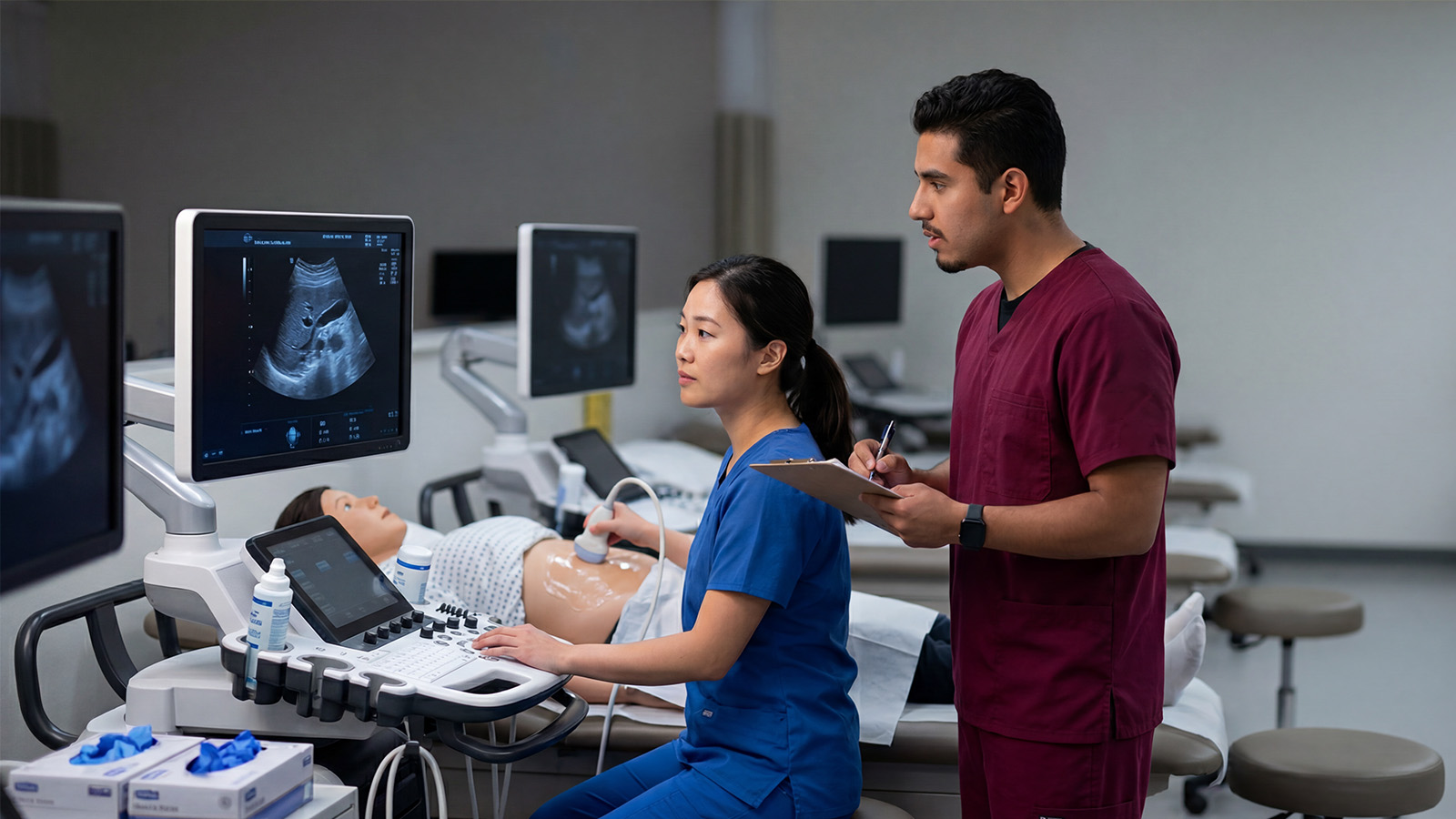
Sonography students practice imaging techniques using ultrasound equipment under supervision.

FAQs & Resources

Frequently Asked Questions

The Diagnostic Medical Sonography Program is located on the Foothill College Campus in Los Altos Hills, California, just off Highway 280 in Silicon Valley approximately 40 miles south of San Francisco and 10 miles north of San Jose. Classroom facilities are adjacent to Parking Lot 5.

Mailing Address, Maps and Driving Directions

The DMS program is fully accredited by The Commission on Accreditation of Allied Health Education Programs (CAAHEP) and Joint Review Committee on Education in Diagnostic Medical Sonography (JRC-DMS).

The Foothill College Diagnostic Medical Sonography program is one of 12 accredited general concentration programs in California as listed in the CAAHEP directory: Commission on Accredation of Allied Health Education Programs.

The DMS program has numerous partnerships with affiliate hospitals and medical facilities throughout the bay area region within 125 miles from the campus as well as the Sacramento and Central California. Students are assigned to a training facility closer to where he/she lives.

Christel Gho, Interim Program Director
Email: ghochristel@fhda.edu

Building 5200

Nancy Cheung, Division Dean
Phone: 650.949.7643
Email: cheungnancy@foothill.edu

Sorry, as each DMS class graduates the new incoming class is assigned to the clinical education centers. To afford maximum learning experience the ratio of student to clinical education center is 1:1. Part-time is not an option. A combination of campus classes and clinical education is 40 hrs/wk.

The job marked is very good. Activity shows the number of positions available exceed the number of qualified applicants. Starting graduate salaries in the San Francisco Bay area are $50-60.00/hr plus benefits. See our jobs page for possible job offerings.

The student should apply to Foothill College and get a Student ID#.  The high school student can meet with an academic counselor and create an education plan to satisfy the prerequisites for the program.  They may enroll in prerequisite or general education courses while in high school.

To meet the patient care experience requirement, the student should consider applying to our other Health Career programs where they will gain this experience as part of the curriculum. 


A minimum of 2-years of patient care experience is required for the program.

To understand if your experience counts.  Email our division office healthcareerprograms@fhda.edu and we will connect you with a DMS faculty to assist you.   Tell us about your experience, duties, responsibilities as well as how long you worked or volunteered for this experience.

The following fees apply to the DMS program. All fees are subject to change.

Tuition Fees (see college fees)
Total Units for DMS Program  116.5
Materials Fees $60.00
Uniforms and Shoes $200.00

Additional Program Expenses: example

Books approximately $ 1,500.00
ARDMS nat'l exam fees (minimum) $ 725.00

FINANCIAL AID ASSISTANCE is avaialbe at (650) 949-7245 or by accessing our online guide. Also the Steve & Lola Kaider Health Care Scholarships for reentry into health care careers (only through Foothill-DeAnza Community College District).

Please note, in addition to the program fees, you are responsible for all Foothill College enrollments fees.

Program Overview

Diagnostic Medical Sonography is a healthcare profession that uses high-frequency sound waves (ultrasound) to create images of organs, tissues, and blood flow to assist physicians in diagnosing medical conditions.
Graduates earn an Associate Degree or Certificate in Diagnostic Medical Sonography, depending on the program track, and may be eligible to apply for national certification exams through the ARDMS.
No. The DMS program follows one unified curriculum track. Students complete the same program requirements regardless of whether they are pursuing a degree or a certificate.
Yes. Admission is competitive due to limited enrollment and clinical placement availability. Meeting minimum requirements does not guarantee acceptance. We accept 15 to 18 students every application period.
No. In‑progress prerequisite courses or DPCE hours are not accepted. All required coursework must have final grades posted, and all DPCE must be fully completed by the application deadline.
The DMS program is 18 months in length, including required clinical education.
Yes. The DMS program is a full-time, rigorous academic and clinical program. Students are expected to prioritize coursework, laboratory practice, and clinical rotations, which often exceed 40 hours per week.
Students should plan for a significant weekly workload that includes classroom instruction, hands‑on laboratory practice, clinical rotations lasting 8–10 hours per day, and independent study. The total weekly commitment often exceeds 40 hours. Classes are held Monday through Friday, typically from 8:00 a.m. to 4:00 p.m., unless otherwise noted.
Due to the intense academic and clinical time commitment, working while enrolled in the DMS program is strongly discouraged. Students who choose to work should carefully consider whether employment may interfere with their ability to meet program expectations.
Not yet. Students cannot enter the DMS program directly from high school. Before applying, you’ll need to complete the required general education courses and gain the necessary Direct Patient Care Experience (DPCE) before applying through a separate application. Many students use this time to explore allied health roles and build experience.

Direct Patient Care Experience (DPCE

DPCE is paid, hands-on experience providing direct care to patients in a healthcare setting with meaningful responsibility for patient care activities.
Yes. DPCE is required for admission. In-progress DPCE is not accepted at the time of application.
All required DPCE must be completed prior to submitting an application to the DMS program.
DPCE must consist of paid, direct, hands-on patient care. Observation, shadowing, and volunteer experience do not qualify. Only the occupations listed on the Foothill College DMS website are accepted for DPCE eligibility.
If your job title does not appear on the list of approved allied health occupations on the Foothill College DMS website, it does not meet the Direct Patient Care Experience (DPCE) requirement. Only the specific roles identified on the program website are accepted.
DPCE hour requirements are based on the type of educational program completed, not on whether a student is pursuing a degree or certificate.
Applicants who hold an associate degree or higher are not required to document 3,000 hours of Direct Patient Care Experience (DPCE). However, the degree must be in a field that aligns with one of the approved allied health occupations listed on the Foothill College DMS website. The exception to this is applicants who have a bachelor’s degree in Kinesiology and international medical degrees. See below for special DPCE requirement.
Applicants from certificate programs (less than two years of formal education) must complete 3,000 hours, representing a two-year full-time equivalent.
Applicants must submit official documentation of paid employment, including pay stubs.
Applicants with a bachelor’s degree in Kinesiology must document one year of paid work experience as a Physical Therapy Assistant (PTA). One year is defined as 1,500 hours of full‑time, direct patient care. Please submit paystubs or other official payroll documentation to verify these hours.
Yes. Applicants with an international medical degree may meet the Direct Patient Care Experience (DPCE) requirement. However, you must verify transcripts with Foreign Transcript Evaluation Services and complete the Foothill College general education plan in order to earn the DMS associate degree. If the GE requirements are not completed, program completion will be delayed.
No. Only paid, direct patient care experience may be used.

Program Requirements

Students must meet technical standards including standing for extended periods, moving equipment, and assisting patients.
Yes. Clinical placement requires background checks, drug screening, immunizations, TB testing, and CPR certification.
The costs associated with the DMS program include standard Foothill College tuition and enrollment fees, along with program‑specific expenses such as 116.5 units of coursework (approximately $3,612), a $60 materials fee, and about $300 for required uniforms and shoes. Students should also plan for additional expenses, including an estimated $1,500 for textbooks, approximately $700 in ARDMS exam fees for the SPI, Abdomen, and OB/GYN exams combined, and personal travel costs to and from clinical sites. Travel expenses vary depending on clinical placement location and individual commuting needs.
Eligible students may apply for financial aid, grants, and scholarships through the Foothill College Financial Aid Office. The DMS department does not provide financial assistance and does not offer program‑specific scholarships, grants, or loans. For more information about available funding and how to apply, please visit the Financial Aid Office webpage.

Clinical Education

Clinical rotations are supervised, hands‑on training experiences completed at approved healthcare facilities affiliated with Foothill College. During these rotations, students apply classroom knowledge in real patient‑care settings, develop technical scanning skills, and gain experience working alongside credentialed sonographers and other healthcare professionals.
Clinical sites are assigned by the program, and placement near your home cannot be guaranteed. Assignments depend on site availability, accreditation requirements, and ensuring all students receive equitable clinical training opportunities.
The program makes every effort to place students at clinical sites as close to their home as possible; however, placement near home is not guaranteed. Clinical sites may be located outside a student’s immediate geographic area, and students are responsible for reliable transportation to and from their assigned site.

Certification & Employment

Graduates may be eligible to sit for ARDMS national certification exams such as Sonography Principles and Instrumentation (SPI), Abdomen, and OB/GYN.

Licensure requirements vary by state; most employers require national certification through ARDMS.
Graduates may work in hospitals, outpatient imaging centers, physician offices, and clinics.
Successful students are professional, dependable, organized, and committed to patient-centered care.
Contact information for the DMS program is listed on the right side of this page. You may also reach out to the Foothill College counseling department for additional guidance and support.

Resources & Links

Manufacturers of Ultrasound Equipment

Continuing Education Courses

The following courses are open to the medical community as continuing education courses.

Contact the program for further information.

  • Sectional Anatomy
  • Introduction to Vascular Sonography for the RDMS and RDCS
  • Advanced Principles in Vascular Sonography


Contact banner image

Contact Us

Christel Gho, Interim Program Director

Diagnostic Medical Sonography
Building 5200
ghochristel@fhda.edu
Image Description

Keep Exploring

Love Your Learning at Foothill College.