Faculty & Staff Directory
Department
Division
Classes I Teach
2026 Fall
| CRN | Course | Section | Title |
|---|---|---|---|
| 20018 | BIOL 40A | 01 | HUMAN ANATOMY & PHYSIOLOGY I |
| 20087 | BIOL 40A | 02 | HUMAN ANATOMY & PHYSIOLOGY I |
| 20790 | BIOL 40A | 05Y | HUMAN ANATOMY & PHYSIOLOGY I |
| 20791 | BIOL 40A | 06Y | HUMAN ANATOMY & PHYSIOLOGY I |
| 21160 | BIOL 40A | 07Y | HUMAN ANATOMY & PHYSIOLOGY I |
| 21161 | BIOL 40A | 08Y | HUMAN ANATOMY & PHYSIOLOGY I |
No scheduled classes found for 2026 Summer.
2027 Winter
| CRN | Course | Section | Title |
|---|---|---|---|
| 31392 | BIOL 40A | 05 | HUMAN ANATOMY & PHYSIOLOGY I |
| 31405 | BIOL 40A | 06 | HUMAN ANATOMY & PHYSIOLOGY I |
| 32503 | BIOL 40A | 07Y | HUMAN ANATOMY & PHYSIOLOGY I |
| 32504 | BIOL 40A | 08Y | HUMAN ANATOMY & PHYSIOLOGY I |
2027 Spring
| CRN | Course | Section | Title |
|---|---|---|---|
| 40104 | BIOL 40A | 01 | HUMAN ANATOMY & PHYSIOLOGY I |
| 40130 | BIOL 40A | 02 | HUMAN ANATOMY & PHYSIOLOGY I |
| 40023 | BIOL 40C | 01 | HUMAN ANATOMY & PHYSIOLOGY III |
| 40151 | BIOL 40C | 02 | HUMAN ANATOMY & PHYSIOLOGY III |
About Me
I’m an Instructor in the Biology Department, where I have taught anatomy and physiology
since 2019. I believe that a great scientist, doctor, nurse, or other professional
can come from anywhere. That belief is why I teach at a community college. My roots
are in Salento, in southern Italy. My scientific training took me to Rome’s “La Sapienza”
for a doctorate in molecular biology and vertebrate development, then to The Rockefeller
University in New York City. Today, as an Adjunct Assistant Professor at UCSF, I study
how cells interpret signals and regulate genes, connecting development and RNA biology
with vascular disease. Until recently, I was also a Biology Instructor at Santa Clara
University. What I bring from research into teaching is a way of approaching the unfamiliar:
ask a precise question, follow the evidence, and revise your explanation when it no
longer holds. Students bring their own ways of seeing, shaped by their cultures, languages,
work, and family life. I want our classroom to be a place where those experiences
inform scientific inquiry, and where each student develops a perspective they can
carry into their chosen field. That takes work. Anatomy and physiology are hard, and
the body has little respect for chapter boundaries. Understanding it requires us to
connect ideas, practice patiently, and return to problems we could not solve the first
time. In the spirit of JFK’s moon speech, I welcome a challenge that draws out our
best abilities. These courses open career doors while developing the judgment and
persistence those careers demand. My responsibility is to make that challenge worthwhile,
with clear expectations, useful feedback, and opportunities to improve. Excellence
grows through dedicated, persistent effort, supported by teaching that recognizes
different strengths, starting points, and constraints. I aim to help each student
achieve their best and earn confidence in what they can do. This guides my work redesigning
A&P: connecting lecture, laboratory work, and assessment around knowledge students
can retain and use in professional practice. My research into teaching also asks how
emerging technologies can help students think for themselves. With colleagues, I coauthored
a published pilot study of a framework for critical use of AI in scientific writing.
Students should be able to question a convincing answer, including one delivered by
a very confident machine. I also want students to experience research firsthand. In
my computational research, Foothill undergraduates have helped evaluate gene-editing
candidates for alkaptonuria, a rare inherited disorder. Their supervised checks of
sequences and designs help prepare for future experiments. They contribute to an investigation
with open questions and learn the care and persistence that such work requires. Outside
work, I enjoy scuba diving among coral reefs and creative writing. A future scientist,
doctor, or nurse may arrive by a route unlike mine, with a way of seeing I have never
considered. I want to be ready to teach that student and to learn from what they bring.
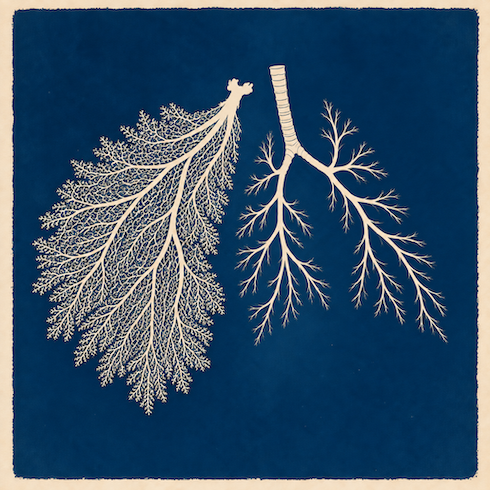 Ivory sea fan and human airway tree spreading downward from separate ends near the
upper center of a deep blue square.
Ivory sea fan and human airway tree spreading downward from separate ends near the
upper center of a deep blue square.