About Us
Foothill College History
Linking Past and Present Voices
Imagine you are living in the foothills of the bay several thousand years ago. As you look across a meadow of new chia and sage sprouts you see the sun nudging over the top of the east bay hills. It is a crisp morning and you are excited to go collect fish from the nets in the baylands. The village is waking up, but you want to leave before your mom tells you to gather acorns instead.
People have lived here for 10,000 years. Their ancestors still live here.
Muwekma Ohlone Tribal members are fighting for recognition from the U.S. Federal Government and from us. We can give them the consideration of listening and helping them make this happen.
It begins by acknowledging their place on this land and becoming stewards of this place with them. It means that we understand the delicate balancing act that is our relationship with the environment.
A historical connection to this space will provide that sense of place. It will also help us rebuild the community that was Foothill College for the past 60+ years.
Because it was an amazing success story.
A small college in downtown Mountain View outgrew its building, so local members of the community decided to buy lands in the foothills from two families who stayed in beautiful Victorian homes and tended apricot orchards along the Adobe Creek. The Griffin and Lohman properties combined was more than enough space for a campus, but it was on top of a low slung set of hills.
Architects were hired, plans drawn up, and heavy machinery transformed the landscape into exactly what we see today. Nothing has changed. The legacy of the Griffin’s love of Japanese culture was embraced and connected people to the gorgeous campus.
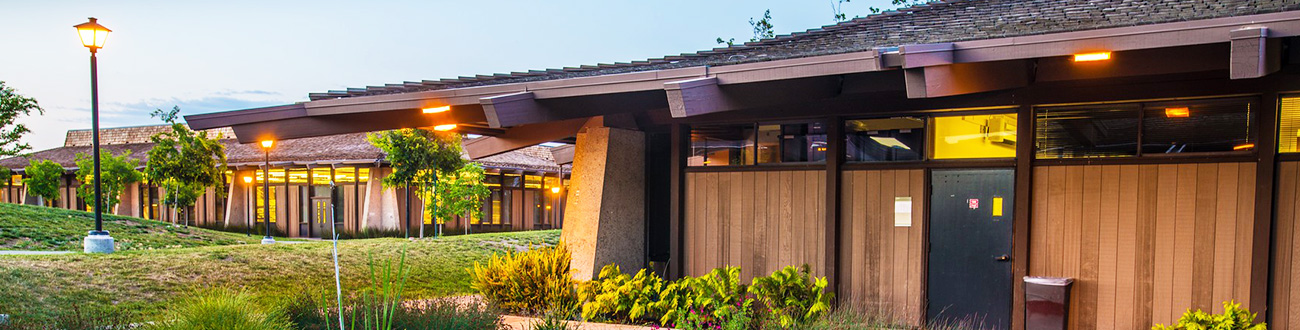
Today that same feeling permeates every newcomer to this place. It is an amazing architectural and landscaping wonder. Imagine what it would take to flatten an entire ridge and transform it with athletic fields, an Olympic sized pool, a massive library, state of the art classrooms, and a ring road encircling it all.
History
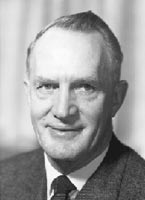
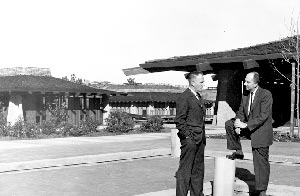
Foothill College is regarded as one of the most beautiful and successful community colleges in the United States. Foothill’s reputation for excellence dates back to its founding Superintended/President Calvin C. Flint and founding Board of Trustees. In July of 1956, Henry M. Gunn, superintendent of Schools in Palo Alto, called a meeting of neighboring schools superintendents and board members to discuss the idea of forming a junior college. After 18 months of study, the formation of a community college district was approved by the California Department of Education. In January 1957, an interim Board of Trustees was appointed by the county superintendent of schools, including Merrill M. Vanderpool, chairman; Nathan C. Finch; A.P. Christiansen; Dr. Howard Diesner; and Dr. Robert Smithwick. In July, the first elected Board of Trustees was seated including Smithwick as chairman, Christiansen, Diesner, Mary Levine and Robert F. Peckham. A search for a new superintendent attracted Flint to head up the new district in March of 1958, leaving his post as president of Monterey Peninsula College. {Figure left: Dr. Calvin Flint}
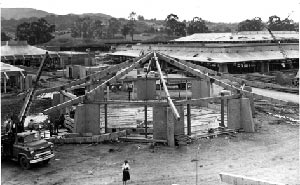
Flint’s idea was to build a community college that would define a new level of quality and innovation within the community college system. After receiving voter approval for a $10.4 million bond May 20, 1958, Flint began working with renown architects Ernest J. Kump of Palo Alto, and Masten & Hurd of San Francisco. On Sept. 15, 1958, the Board of Trustees selected a 122-acre site in Los Altos Hills as the permanent location of Foothill College. The site encompassed property that had originally been part of the Taaffe Partition of Rancho Purissima. Portions of the Taaffe land were later owned by the Lohman and Cusack families.
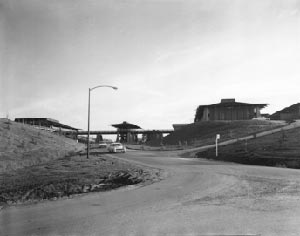
Flint and the Board had the rare opportunity to design and construct an entire campus at once. Flint and an administrative and faculty team made the most of the opportunity, developing their campus with the student and faculty member in mind. Flint was quoted as saying, “The college must convey an atmosphere of its being friendly, personalized and informal. Offices of faculty, counselors and administrators must be readily accessible to students.” {Figure right: campus construction 1961}
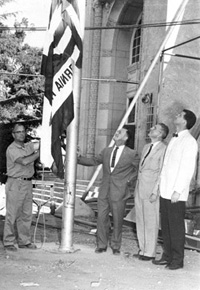
With this direction in mind, Kump and Masten & Hurd went on to design what would later be called a “major work of architecture and planning, possibly the finest design yet devised by the distinguished office of Ernest J. Kump,” by the San Francisco Chronicle. Prior to its completion, the campus received a Design Award from Progressive Architecture Magazine in 1960. Upon completion in September 1961, it was clear the Foothill board and its administration had created something special and enduring for its community. The campus received accolades and awards from around the nation. In 1962 Time Magazine said, “Starting from scratch, Flint has already made Foothill a mountaintop among U.S. junior colleges–the fastest growing segment of U.S. Higher Education.” The American Institute of Architects gave the campus an Honor Award in 1962 and an Award of Merit in 1963. In 1980, the campus received a Special Commendation from the same group for “excellence in design that has stood the test of time.” {Figure left: raising the US and California flag at original site}